Plasma, in the classroom
The fourth state of matter fits in one sentence and shows itself in three seconds. Workshops, demonstrations and technical training from elementary school to university, run by the team that designs the reactors.
Engineers and researchers are the ones who show up, not a sales team. And if all you want is material to use on your own, the online resources are free and require no sign-up.
Kalego started in a laboratory at Université Laval. We never really left the education world.
Elementary, high school, college and university. The subject stays the same, the reading level does not.
Articles, application sheets and selection guide: free to use in class, no form to fill.
One plasma, four readings
A plasma discharge is a rare thing in teaching: it is spectacular on first sight and still rigorous on the tenth. That is what lets us bring it to fourth-graders and to master's students without changing the demonstration.
It glows, and it changes matter
We stay with what can be seen. A violet light appears without a flame, and right after, a water droplet that used to roll off a plastic spreads flat across it. The word "plasma" comes after the observation, not before.
- Solid, liquid, gas… and the fourth one
- Observe, describe, compare before and after
- Plasma in nature: northern lights, lightning
A gas torn away from itself
We connect the observation back to the curriculum: atomic structure, ionization, energy transfer. The water droplet becomes a measurement, with a test ink giving a number in millinewtons per metre.
- Atom, electron, ion: what the discharge moves
- Surface tension and surface energy
- Green chemistry: replacing a solvent with a dry process
A process, with its parameters
For technical programs — engineering, analytical chemistry, materials processing — we get into the process itself: power, gas, line speed, distance, and how reproducible the measurement really is.
- Dielectric barrier discharge: the principle
- Contact angle: protocol and sources of error
- Ageing of the effect: why a surface "falls back"
From the lab to the production line
Discharge physics, surface chemistry, thin-film deposition — and the part that is rarely taught: what breaks when a laboratory process has to hold industrial pace.
- Atmospheric or vacuum plasma: the real trade-off
- Functionalization and deposition: surface mechanisms
- Technology transfer and research commercialization
Five ways to bring us in
Each format states what the group sees, what it leaves with, and what we need from your side. They combine: a talk in the morning, a workshop in the afternoon.
-
Discovery workshop
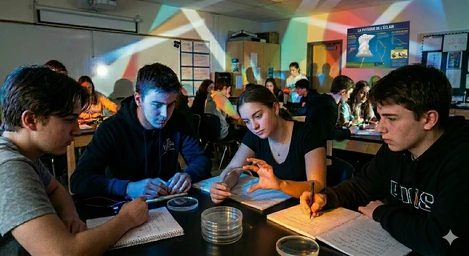
At your schoolThe full activity, in your science room: we light a discharge in front of the group, treat a sample, and the students measure for themselves what changed on the surface. This is the format that leaves the most behind.
The group leaves withA measurement made with their own hands, before and after treatment, and the treated samples.
From your sideA room with power outlets and tables, and the group's level so we can set the vocabulary.
-
Demonstration
Short versionThe same discharge, without the hands-on part: the format that fits inside one class period, a career day or a science fair. Bring a part of your choosing and we will treat it in front of the group.
The group leaves withThe image of a plasma lit in open air, and proof that it changes a surface.
From your sideA power outlet, and the object to treat if you have one in mind.
-
Outreach talk
Large groupTwo subjects, separately or together: cold plasma and its industrial uses, or the path of a technology from a university laboratory to a company — funding, prototypes, first customers, mistakes included.
The group leaves withA concrete example of research turned into a product, told by the people who did it.
From your sideA room and a projector. The content is set against your curriculum.
-
Technical training
College · UniversityFor laboratory technicians, research teams and technical programs: plasma surface treatment as a process, with its parameters, its characterization methods and its limits. The same content we pass on to an industrial client.
The group leaves withA reproducible measurement method, and enough to judge whether plasma answers a given research question.
From your sideYour samples and your laboratory objectives, so we work on your materials rather than ours.
-
Visit our facility
Quebec CityThe group comes to see the production reactors and the characterization stations at our facility in Quebec City. It is the format that best shows what a scientific job actually looks like once school is over.
The group leaves withA clear picture of the jobs behind the technology: design, process, characterization.
From your sideTransport, supervision of the group, and a date agreed in advance.
Duration, group size and travel are set against your schedule: tell us the school level, the number of groups and the period you have in mind, and we will come back with a proposal. Write to the team →
Equipment, not slides
A plasma activity that shrinks down to a slide deck misses the one thing that makes it useful: the moment a student measures, personally, a difference they just watched appear. Here is what walks into the room with us.
The plasma source
- A discharge visible in open air, with no vacuum chamber
- A so-called "cold" plasma: close to room temperature
- Handled by our staff, never by students
- How a DBD reactor works →
The test inks
- Surface energy read in seconds, in mN/m
- An abstract notion turned into a comparable number
- Simple enough to stay in the students' hands
- See the test inks →
The samples
- Polymers, glass, metal: same treatment, different effects
- The water droplet test, before and after
- Your own objects if you bring some
- The six plasma applications →
The written resources
- Three in-depth articles, written without jargon
- A decision guide between atmospheric and vacuum plasma
- One sheet per industrial sector, useful for research projects
- Open the resources →
The concepts it touches
A single activity crosses physics, chemistry and technology. Depending on the level we lean on one or the other — that is really the only thing that changes from one group to the next.
States of matter
Solid, liquid, gas — then the fourth one, which makes up most of the visible matter in the universe and is almost never met in a classroom.
Ionization and discharge
What it takes to strip electrons from a gas, and why the emitted light has the colour it has. The direct link to lightning and to the northern lights.
Surface tension
Why a droplet stays round on a plastic and flattens on glass, and how that observation is turned into a number. See wettability →
Adhesion and interfaces
What makes a glue, an ink or a paint hold — or peel. A question of interface, not of product. See adhesion →
Green chemistry
Replacing a solvent-based primer with a dry process: no volatile organic compounds, no bath to treat, no drying time. A textbook case of substitution.
Research and innovation
How a laboratory result becomes a piece of equipment on sale: patents, funding, prototypes, and everything that fails in between. Our story since 2019 →
Preparing a specific unit and want us to plug into it? Send us the chapter title: we adapt the vocabulary and the examples rather than running through generic content.
Equipping a laboratory
A plasma reactor installed in a teaching laboratory earns its place twice: it runs the demonstration in front of the group, and it carries the final-year projects the rest of the year. Our equipment is the same as in production — there is no watered-down "education" range.
Kalego was born in a laboratory at Université Laval in 2019 and has worked with research teams ever since, notably through Mitacs and the Fonds de recherche du Québec. Which means we know what a lab budget looks like, and what a grant calendar does to a project.
- The cheapest option first Test inks make surface energy measurable in class with no equipment at all. See the test inks →
- Have your samples treated Before buying anything: we treat your specimens at our facility and you confirm the value for your project. Send samples →
- Choose a piece of equipment Compact torch, DBD reactor or coating station, depending on the kind of projects the laboratory has to carry. See the catalogue →
- Build a project together Internship, final-year project, funded research partnership. Describe the project and the timeline, and we will tell you honestly whether we have the capacity to supervise it.
Equipment that lives in a lab
The four configurations most often chosen by a teaching or research laboratory.
- Test inksMeasure without equipping
- Compact plasma torchLocalized treatment, on the bench
- DBD plasma reactorTreatment of flat surfaces
- Coating stationThin films and functionalization
Outreach, from the start
Three public appearances, all verifiable, that give a fair idea of the tone: neither a corporate talk nor a lecture.
Guest on CURIUM
Jacopo Profili, co-founder, special guest on the science show aimed at teenagers, in an episode devoted to energy storage. In French.
Scientific entrepreneurship
Marine Queffeulou, co-founder, on moving from research to entrepreneurship, in front of the French-speaking scientific community. In French.
Professors and student researchers
A student, a researcher and a professor lay out their crossing paths — exactly the subject for groups hesitating between further study and the job market. In French.


Who we are and where the team comes from →
Press coverage and distinctions →
What we get asked before booking
How young can a group be for a plasma activity?
Elementary school works, as long as the angle changes. With younger students we stay with what is visible: the light, the colour of the discharge, the water droplet that suddenly spreads out. In high school we tie it back to states of matter and atomic structure. At college and university we get into discharge physics and surface chemistry.
The equipment itself does not change: what shifts is the vocabulary and the level of justification.
Does the activity happen at the school or at Kalego?
Both work. The discovery workshop and the demonstration take place in your science room. The site visit happens at our facility in Quebec City, where the group sees production reactors and characterization stations.
It mostly comes down to your transport logistics — and to what you want to show: the phenomenon, or the job.
Is lighting a plasma in front of a class dangerous?
Cold atmospheric plasma runs close to room temperature — that is exactly what allows a plastic film to be treated without deforming it. The demonstration is run by our staff, with the equipment and safety distances meant for that use.
Students handle the samples, the water droplets and the test inks — never the discharge.
How much does an activity cost?
Write to us with the school level, the number of groups and the period you have in mind, and we will come back with a proposal matched to the format chosen and to the travel involved.
The online resources stay free and open for classroom use, with no sign-up and no form. Open the resources →
Can we use your content in class without booking you?
Yes, and we encourage it. The articles explain plasma surface treatment, the difference between atmospheric and vacuum plasma, and how adhesion is improved. They are written without jargon and work as preparatory reading or as project material.
Plasma surface treatment explained →
Atmospheric or vacuum plasma →
Do you equip teaching laboratories?
Yes. Our DBD reactors, compact torches and coating stations are used in teaching laboratories as much as in production — it is the same hardware, not a stripped-down range.
Surface energy test inks remain the cheapest way to turn an abstract notion into something measurable in class. See the catalogue →
Do you supervise student projects or internships?
Kalego was born in a university laboratory in 2019 and has worked with research teams ever since, notably through Mitacs and the Fonds de recherche du Québec.
Describe the project, the funding program you have in mind and the timeline, and we will tell you honestly whether we have the capacity to supervise it. Supervision that is badly sized helps no one.
Are activities available in French?
Yes. Activities and training sessions are delivered in French or in English. Just tell us the language of the group in your request. Cette page en français →
Read first
Whether or not you book us, everything below is freely available and can be used in class. No form, no sign-up.
Plasma explained
What the fourth state of matter is, and what it does to a surface. No jargon.
All the resources
In-depth articles, a decision guide and technical documentation, freely available.
The six applications
Cleaning, wettability, adhesion, thin film, anti-fog, sealing: six ready-made project subjects.
Plasma by sector
From medical to aerospace: where this science is practised, and in which jobs.
Tell us about your group
The school level, the number of students and the period you have in mind are enough to get started. Someone from the technical team answers.