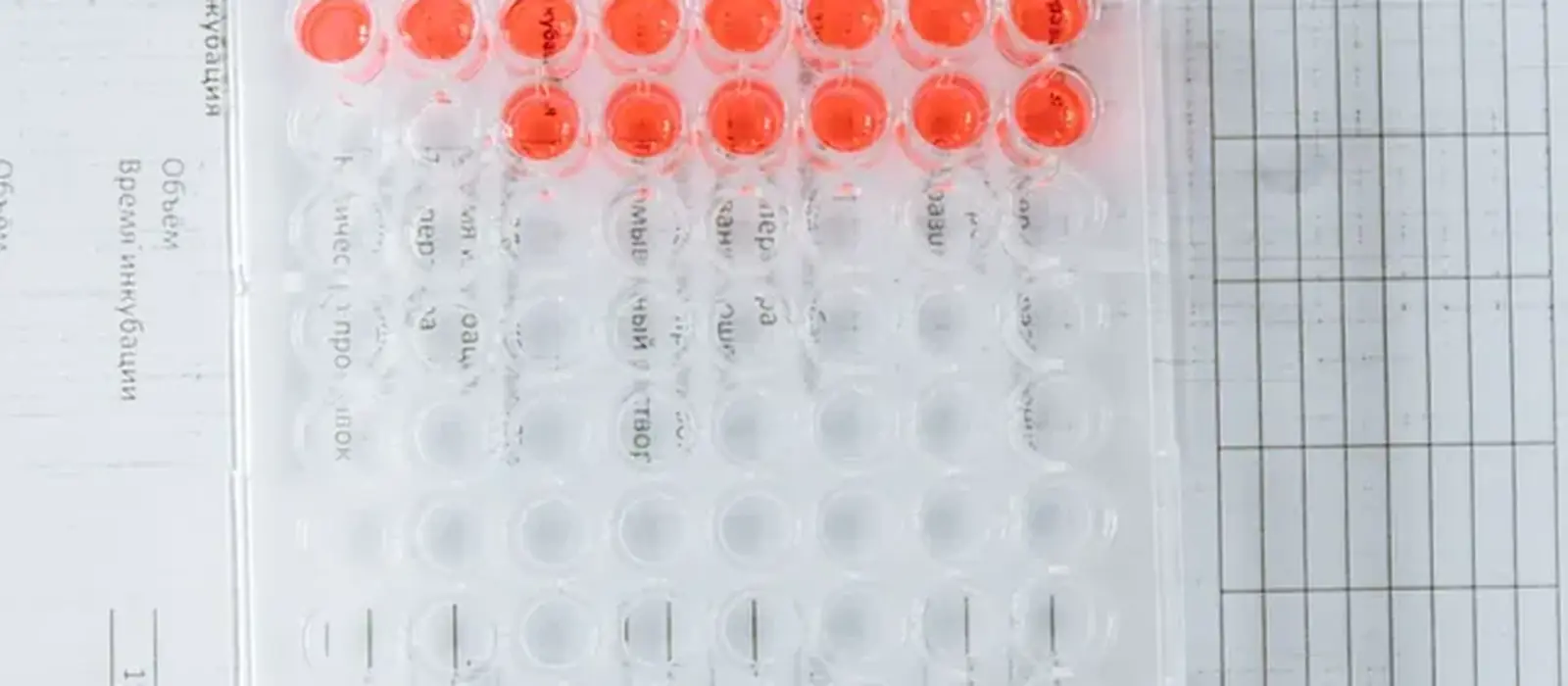
Biotechnology with functional surfaces
Functionalisation for cell culture, microchannel wettability and bonding preparation for lab-on-chip devices.
The surface challenge
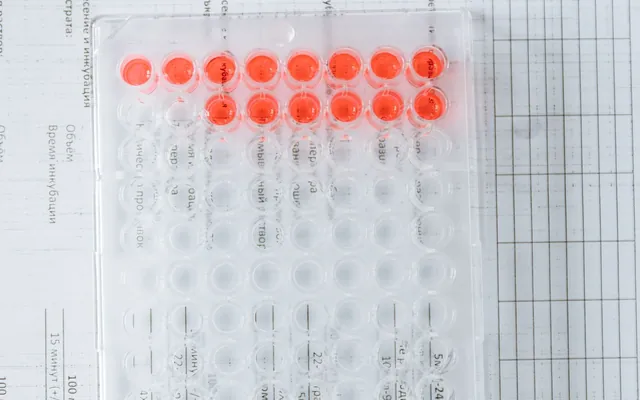
In biotechnology, the surface is in dialogue with living matter. A poorly functionalised culture dish and cells adhere badly; a microchannel that is too hydrophobic and the fluid does not flow as intended.
Plasma finely tunes the chemistry and surface energy of laboratory polymers. It also prepares the sealing of microfluidic chips.
What plasma changes
| Indicator | Before | After plasma | Method |
|---|---|---|---|
| Surface energy — polystyrene | 34 mN/m | 45 to 66 mN/m | Test inks |
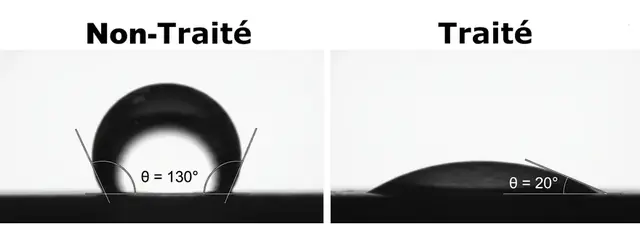
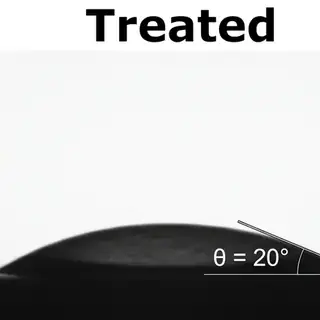
| Contact angle — polystyrene | ≈ 87° | 35 to 70° depending on exposure | Goniometer |
| Contact angle (water) | 90 to 105° (polyolefins) | 35 to 70° depending on exposure | Goniometer, sessile drop |
| Effect retention | — | near-logarithmic decay; still hydrophilic at 7 days | Controlled ageing |
| Pass speed | — | 6 to 120 m/min per source | Configuration to be validated |
Documented order-of-magnitude figures, not our own measurements: pre-treatment values come from the Accu Dyne Test reference tables, the post-treatment range for polymers — 45 to 66 mN/m — from three studies on atmospheric-plasma-treated polypropylene (Šrámková et al., Polymers 13, 4173, 2021; Leroux et al., J. Colloid Interface Sci. 328, 412, 2008; Shaw et al., Plasma Sources Sci. Technol. 25, 065018, 2016). On polymers that already start high — polyamide, polycarbonate, epoxy composite — the gain reads in contact angle rather than mN/m: PA 6 from 70° to 21-28° (Karoly et al., Polymers 10, 1380, 2018), PC from 81.5° to 38-46° (Kelar et al., Polymer Testing 67, 428, 2018), carbon/epoxy composite from 109° to 32° (Sun et al., Polymers 11, 139, 2019). They place the process — they still depend on the substrate, its geometry and the line speed. A trial on your own part gives you your own numbers. Have my material measured.
What plasma changes
-
01
Cell culture surfaces
Promote cell adhesion and proliferation.
-
02
Microchannel wettability
Ensure controlled fluid flow.
-
03
Chip bonding
Prepare the sealing of lab-on-chip devices.
-
04
Chemical functionalisation
Graft targeted surface functions.
From your sample to your line
-
 01
01
Characterisation
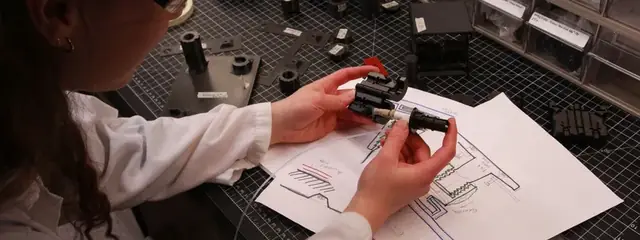
You send us a sample. We measure its starting surface energy and identify what is blocking adhesion: contamination, release agent, non-polar polymer.
-
 02
02
Parameter trial
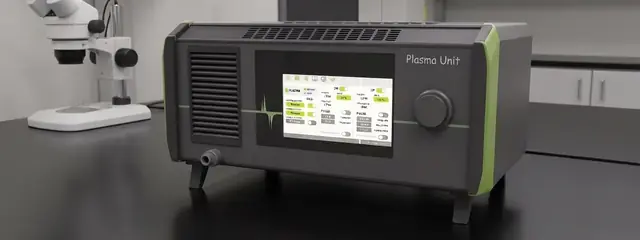
We vary power, pass speed, nozzle-to-substrate distance and gas until the target effect is reached, and record the parameters that got us there.
-
 03
03
Validation
We check the result with the test that matters to you — adhesion, sealing, wetting — and document how long the effect holds on your material.
-
 04
04
Integration
At the station, in batches, or in a reactor for volume. Repeatability matters more than throughput.
Activation or deposition: two regimes, two lifetimes. The detailed comparison.
What plasma does, in detail
-
Wettability
Spreading a liquid evenly, with no dewetting or pull-back.
-
Adhesion
Making adhesive, ink or paint hold on a non-polar polymer.
-
Thin film
Depositing a function — barrier, hydrophobic, tie layer — from 1 to 300 nm.
- All applications All six treatments in the catalogue, explained one by one.
The right equipment for this sector
-
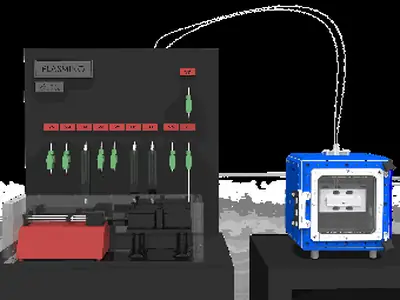
Plasmino DBD reactor
Batch treatment under controlled atmosphere, same recipe run to run.
View the family -
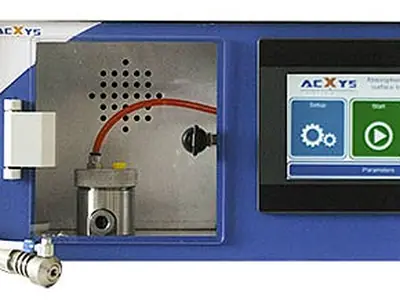
Thin-film deposition station
To graft a chemical function rather than only activate.
View the family -

Powder and granulate stations
For powders, granulates and bulk supports.
View the family
The final choice is made on your part and your cadence, not from a catalogue. All equipment, sorted by the problem it solves.
Frequently treated materials





This list is indicative. The vast majority of polymers, metals, glasses and composites can be treated with DBD plasma. The best way to confirm your case is to send us a description of your part and your objective. For the hardware, see the plasma equipment sorted by the problem it solves.
What we get asked — Biotechnology
How long does the treatment effect last?
Activation is not permanent: surface energy decays after treatment, faster on mobile polymers and in warm storage. That is why plasma is placed immediately before the step it serves — printing, bonding, sealing. The decay rate is measurable, and we document it on your material during the trial.
Does plasma replace corona treatment?
Both raise surface energy, but not under the same conditions. Corona suits flat film running over a roller. Atmospheric DBD plasma also treats three-dimensional geometries, hollow parts and non-conductive surfaces, with a uniformity that does not depend on holding a constant air gap. On your part, the answer is settled by comparison, not by principle.
Does the treatment change the part's appearance or dimensions?
No. Plasma acts on the first few nanometres of the surface: mass, dimensions and bulk mechanical properties are unchanged. On heat-sensitive substrates, parameters are adjusted to avoid any marking, and that is one of the things checked at the validation stage.
Are chemicals or a drying step required?
No. The treatment runs on electricity and process gas, with no primer, no solvent and no drying time. That is what lets it sit inside a line without lengthening the cycle, and what removes a hazardous-goods handling station.
Can it be retrofitted to an existing line?
That is the most common case. The treatment installs inline, at production speed. Three things need checking: the space available at the useful point, the electrical and gas connections, and extraction. Those three are what the integration stage covers.
Can a surface be made durably hydrophilic?
Activation alone decays over time; that is its nature. To hold, you move from the activation regime to the deposition regime: a grafted thin film is stable where simple surface oxidation is not. Which one you need depends on the target lifetime and the budget, and it is settled by trial.
The selection guide
Atmospheric or vacuum? The question comes up on every project, and it is settled on three concrete criteria — not on a preference for one process.
- Both architectures, what each one can do and what it costs
- Three deciding criteria: part geometry, robotic integration, cycle time
- A grid to fill in so you can defend the choice to an investment committee
Guide being written — leave your email and you will get it on release.
In the meantime, the article comparing both architectures : The detailed comparison.
Related sectors
-
 Medical
The same surface demand, on regulated devices.
Medical
The same surface demand, on regulated devices.
-
 Optics
The same surface demand, applied to light transmission.
Optics
The same surface demand, applied to light transmission.
-
 Cosmetics
Bottles and labels, seen through decoration.
Cosmetics
Bottles and labels, seen through decoration.
What you send, what you get back
- You send
- [x] samples of your part or film, [x] minimum size.
- You receive
- surface energy values before and after, one treated sample, and a written record of the parameters used.
- Turnaround
- first reply within 48 hours, trial report within [x] business days.
- Cost
- [x]
Send a description of your part and your goal. Answer within 48 hours.
Three fields, and we get back to you
The surface, interface with living systems.
48 hours to find out what plasma can do for your surfaces. No commitment, just clear answers from an expert.
Response within 48 hours. No commitment. A technical discussion with an expert.