Photograph of the machine to come.
Test inks
A treatment you do not measure is not a process, it is a bet. The measurement takes seconds, costs a few dollars, and tells you before you bond whether the joint will hold.
All specifications, further down ↓
- First reply within 48 working hours, from an engineer, not from an automated form.
- Rental available — test the assumption on your own site before committing to the investment.
- Laboratory in Québec City — your samples are treated and characterised here.
- Quoted to specification, with no commitment. We say so plainly if plasma is not the right answer.
Technical datasheet — 2 pages, PDF
Dimensioned footprint, required utilities, protocols. To pass on to your integrator.
To compare, or to complete
The machines our clients look at alongside this one, and the consumable that checks the result.
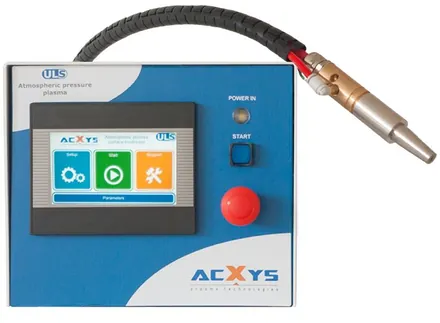 Precise area
Compact torch
A nozzle that blows plasma straight onto the area to be treated, a few millimetres from the part. The most common way to activate a precise area.
View the page → Powders and granulatesSpecialised stations
Some materials cannot be treated like a part: a powder requires every grain to pass through the plasma, in line and with no manual intervention.
View the page →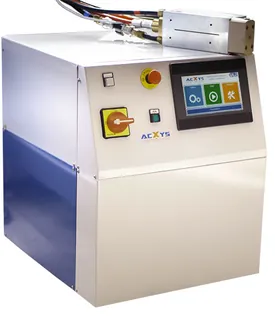 Wide web
Plasma curtain
A continuous curtain across a full width, for panels, sheets or webs on the move. Seven working widths from 60 to 500 mm.
View the page →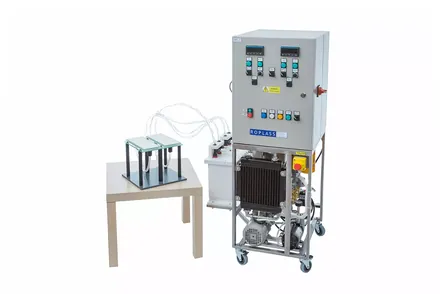 Whole surface
Surface source
A discharge spread across the whole electrode, treating flat parts and flexible films uniformly. No sweeping, so no over-treated band.
View the page →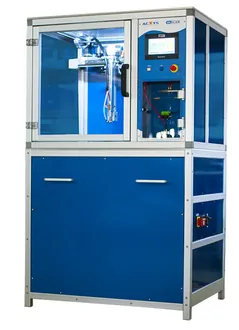 Automated station
Turnkey cell
An enclosed cell with a Cartesian robot, plasma source and safety interlocks. You program a path, the station replays it identically.
View the page →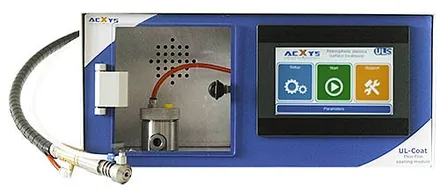 Film deposition
Deposition station
When activating is no longer enough: a 1 to 300 nm functional film deposited by atmospheric plasma, anti-corrosion or anti-scratch depending on the precursor.
View the page →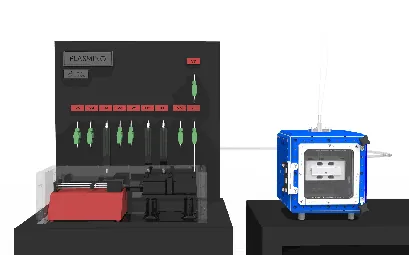 To specification
DBD reactor
No catalogue configuration fits? Our engineers design the reactor to your specification, dimensions and gases included.
View the page →Request a quote
Your configuration is carried into the message. Add your part, your throughput and your material: you get the price, the lead time and the terms.
When this equipment is the right one
Without measurement, the only way to know a treatment worked is to wait for the customer to come back. Test ink moves that check upstream: in seconds and for a few dollars, it gives a figure for surface energy before the critical step.
Before bonding, painting or printing
The line spreads: the surface is above the stated value. It retracts into droplets: it is below, and the next step is going to fail.
To control a production run
On witness samples, the measurement documents how regular the treatment is part after part.
To build a qualification file
It is the numerical proof, backed by a standard, that an auditor can verify.
How it works
What happens at the surface, and what that means for your line.
The ink is calibrated to a known surface tension. Applied to the surface, it spreads if the substrate surface energy is above that value, and retracts into droplets if it is below. Working through the range brackets the real value.
Two ranges cover different needs: the extended range, compliant with ISO 8296 : 2003, compatible with all materials; and the non-toxic range, compliant with ASTM D2578-09, formulated for low surface energy materials such as PTFE, EPDM, PET and PVC.
The figures
The values to check before quoting, plus the document to pass on to your integrator.
What to plan for on your side
The values an integrator asks for before quoting: footprint, utilities, extraction and protocols.
Equipment that does not talk to your PLC stays an isolated station. Before any order, we validate with you the real constraints of your line : protocol, footprint, available utilities and extraction.
These values are indicative and are confirmed at the process study stage, on the configuration actually retained.
- Floor footprint
- [x] mm
- Mass of the assembly
- [y] kg
- Extraction required
- [z] m³/h
- Protocols available
- [x]
- Cable lengths
- 3, 5 or 7 m
- Indicative lead time
- [y] weeks
What we have already treated
What is qualified in the laboratory, and what the machine costs once in service: consumables, maintenance, warranty.
Materials qualified in the laboratory : [x].
Your material is not on the list ? That is the most common case. Send us three samples : we treat them, we characterise them, and you receive a costed answer within 48 hours.
- Electrode service life
- [y] h
- Replacement cost
- [z] $
- Preventive maintenance
- [x]
- Warranty
- [y]
- Rental possible
- yes
Before you write to us
The questions we are asked most often, answered before you have to ask them.
How do I know whether this equipment suits my part ?
By sending it to us. We treat your samples in our Quebec City laboratory and you receive a costed answer within 48 hours : surface energy before and after, the parameters retained, and our frank opinion if plasma is not the right answer to your problem.
Can it be rented before buying ?
Yes. Rental serves to validate a production hypothesis on your site, with your parts and your operators, before committing to an investment. Terms : [x].
What documents do you provide for a customer audit ?
The corresponding process file : the plasma parameters retained, characterisation methods, validation results on your parts and operating procedures. For regulated markets, the level of documentation is adapted to your sector's requirements.
And if no configuration fits ?
Our engineers then design the reactor to specification : dimensions, gases, controllers, interface, sized on your material and your throughput. See the custom reactors →
What this equipment lets you do
Send us a part.
The quickest way to find out whether the test inks suits your process is to let us treat your material. 48 hours for a first answer, no commitment.
Answer within 48 hours. No commitment. A technical discussion with an expert.