Deposition station
Activating a surface makes it receptive; depositing a layer gives it a property it did not have. A functional film of 1 to 300 nm, on the line, with no bath and no oven.
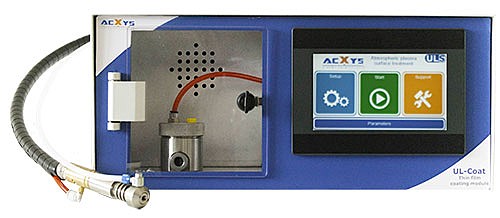
Functional layer · 1 to 300 nm · Anti-corrosion, anti-scratch · No bath, no oven
When this equipment is the right one
Activation prepares a surface to receive; it does not give it a new property. When the need is a barrier, resistance to corrosion or to scratching, a layer has to be deposited — and done without introducing a chemical bath or a drying step into the flow.
A metal part to protect
A barrier layer a few tens of nanometres thick, deposited in line, replaces a wet treatment and its drying cycle.
An optical surface to harden
Scratch resistance is achieved with a thin film that changes neither the geometry nor the optical properties of the part.
A particular surface chemistry
The precursor determines the function obtained. Chemistries other than anti-corrosion and anti-scratch are studied case by case.
How it works
The plasma carries a precursor to the surface and fixes it there as a nanometric film. Deposition takes place at atmospheric pressure, directly on the line: no vacuum chamber, no bath, no oven.
The choice between the two configurations comes down to a single criterion: the air reactivity of the precursor your application requires. A low-reactivity precursor is handled in ambient air with an integrated line; a highly reactive precursor calls for a dedicated line, interchangeable by chemistry.
The figures
Datasheet — 2 pages, PDF
Full specifications, dimensioned footprint, required utilities and protocols. The document to pass on to your integrator or your investment committee.
Choosing the right variant
-
Integrated-line configuration
The most economical, for low-reactivity precursors handled in ambient air. Compatible in particular with silicon-based precursors of the SiOx type.
-
Interchangeable-line configuration
The most versatile, for the precursors most reactive to air. The line is changed according to the chemistry targeted.
What to plan for on your side
Equipment that does not talk to your PLC stays an isolated station. Before any order, we validate with you the real constraints of your line : protocol, footprint, available utilities and extraction.
These values are indicative and are confirmed at the process study stage, on the configuration actually retained.
- Floor footprint
- [x] mm
- Mass of the assembly
- [y] kg
- Extraction required
- [z] m³/h
- Protocols available
- [x]
- Cable lengths
- 3, 5 or 7 m
- Indicative lead time
- [y] weeks
What we have already treated
Materials qualified in the laboratory : [x].
Your material is not on the list ? That is the most common case. Send us three samples : we treat them, we characterise them, and you receive a costed answer within 48 hours.
- Electrode service life
- [y] h
- Replacement cost
- [z] $
- Preventive maintenance
- [x]
- Warranty
- [y]
- Rental possible
- yes
Before you write to us
How do I know whether this equipment suits my part ?
By sending it to us. We treat your samples in our Quebec City laboratory and you receive a costed answer within 48 hours : surface energy before and after, the parameters retained, and our frank opinion if plasma is not the right answer to your problem.
Can it be rented before buying ?
Yes. Rental serves to validate a production hypothesis on your site, with your parts and your operators, before committing to an investment. Terms : [x].
What documents do you provide for a customer audit ?
The corresponding process file : the plasma parameters retained, characterisation methods, validation results on your parts and operating procedures. For regulated markets, the level of documentation is adapted to your sector's requirements.
And if no configuration fits ?
Our engineers then design the reactor to specification : dimensions, gases, controllers, interface, sized on your material and your throughput. See the custom reactors →
The neighbouring equipment
Surface plasma source
A discharge spread across the whole electrode surface, treating flat parts and flexible films uniformly. No sweeping, so no overlap and no over-treated area.
See the page →Turnkey treatment cell
An enclosed cell with a Cartesian robot, plasma source and integrated safety. You program a path, you store it, and the station replays it identically.
See the page →What this equipment lets you do
Send us a part.
The quickest way to find out whether the thin-film deposition station suits your process is to let us treat your material. 48 hours for a first answer, no commitment.
Answer within 48 hours. No commitment. A technical discussion with an expert.