Compact plasma torch
A nozzle that blows plasma straight onto the area to be treated, a few millimetres from the part. The most common way to activate a precise area without touching the rest.
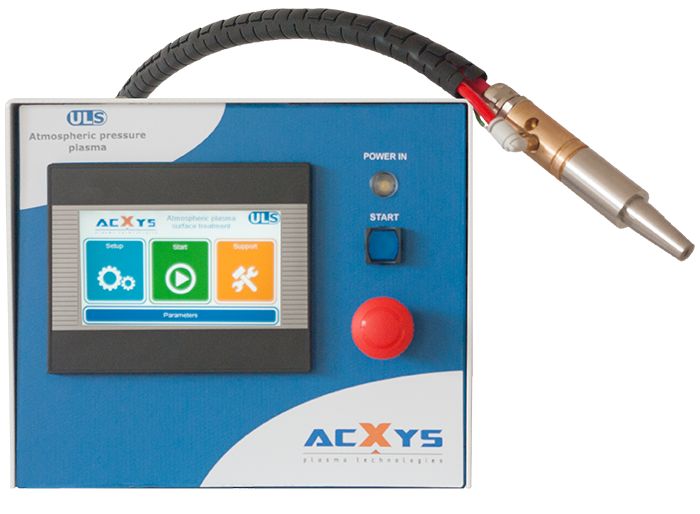
3D parts · 1 to 3 nozzles · 700–1100 W · Robot or fixed-station mounting
When this equipment is the right one
Nine adhesion problems out of ten are solved by raising surface energy just before the critical step. When the area to treat is precise and the part has volume, the torch is the right equipment: it treats exactly where needed, without exposing the rest of the part.
A glue that will not hold on a plastic
The adhesive bead peels off in ageing or in the peel test. The torch activates the bonding strip alone, just before dispensing.
A paint that flakes locally
On a moulded part, residual release agent prevents adhesion. Plasma removes the organic contamination and grafts chemical functions.
A marking or print that bleeds
The ink beads up instead of spreading. One torch pass over the printed area is enough to raise wettability.
How it works
The torch generates a plasma at atmospheric pressure and projects it onto the surface through a nozzle placed a few millimetres from the part. There is no vacuum chamber, no pump-down cycle and no solvent: the treatment slots straight into the production flow.
The nozzle geometry is chosen on access to the area. A continuous nozzle treats a strip as it passes; a rotary nozzle widens the track in a single pass; a 45° nozzle reaches areas a vertical axis cannot see.
The figures
Datasheet — 2 pages, PDF
Full specifications, dimensioned footprint, required utilities and protocols. The document to pass on to your integrator or your investment committee.
Choosing the right variant
-
Laboratory configuration
One nozzle, benchtop format. For R&D and small runs, when the point is still to qualify a process rather than to produce it.
-
Production configuration
One, two or three nozzles, for a pilot or production line. The number of nozzles is sized on the area to cover within the available cycle time.
-
Three nozzle geometries
Continuous, rotary, or continuous at 45°, depending on access to the area to treat and the track width required.
What to plan for on your side
Equipment that does not talk to your PLC stays an isolated station. Before any order, we validate with you the real constraints of your line : protocol, footprint, available utilities and extraction.
These values are indicative and are confirmed at the process study stage, on the configuration actually retained.
- Floor footprint
- [x] mm
- Mass of the assembly
- [y] kg
- Extraction required
- [z] m³/h
- Protocols available
- [x]
- Cable lengths
- 3, 5 or 7 m
- Indicative lead time
- [y] weeks
What we have already treated
Materials qualified in the laboratory : [x].
Your material is not on the list ? That is the most common case. Send us three samples : we treat them, we characterise them, and you receive a costed answer within 48 hours.
- Electrode service life
- [y] h
- Replacement cost
- [z] $
- Preventive maintenance
- [x]
- Warranty
- [y]
- Rental possible
- yes
Before you write to us
How do I know whether this equipment suits my part ?
By sending it to us. We treat your samples in our Quebec City laboratory and you receive a costed answer within 48 hours : surface energy before and after, the parameters retained, and our frank opinion if plasma is not the right answer to your problem.
Can it be rented before buying ?
Yes. Rental serves to validate a production hypothesis on your site, with your parts and your operators, before committing to an investment. Terms : [x].
What documents do you provide for a customer audit ?
The corresponding process file : the plasma parameters retained, characterisation methods, validation results on your parts and operating procedures. For regulated markets, the level of documentation is adapted to your sector's requirements.
And if no configuration fits ?
Our engineers then design the reactor to specification : dimensions, gases, controllers, interface, sized on your material and your throughput. See the custom reactors →
The neighbouring equipment
Plasma curtain
A continuous plasma curtain across a full width, to treat panels, sheets or webs as they pass. For when the surface exceeds what a nozzle can sweep within the cycle time.
See the page →Turnkey treatment cell
An enclosed cell with a Cartesian robot, plasma source and integrated safety. You program a path, you store it, and the station replays it identically.
See the page →What this equipment lets you do
Send us a part.
The quickest way to find out whether the compact plasma torch suits your process is to let us treat your material. 48 hours for a first answer, no commitment.
Answer within 48 hours. No commitment. A technical discussion with an expert.